



Begin of page section:
Page sections:

  • Go to contents (Accesskey 1)
  • Go to position marker (Accesskey 2)
  • Go to main navigation (Accesskey 3)
  • Go to sub navigation (Accesskey 4)
  • Go to additional information (Accesskey 5)
  • Go to page settings (user/language) (Accesskey 8)
  • Go to search (Accesskey 9)

End of this page section. Go to overview of page sections

Begin of page section:
Page settings:

English en
Deutsch de
Search
Login

End of this page section. Go to overview of page sections

Begin of page section:
Search:

Search for details about Uni Graz
Close

End of this page section. Go to overview of page sections


Search

Begin of page section:
Main navigation:

Page navigation:

  • University

    University
    • About the University
    • Organisation
    • Faculties
    • Library
    • Working at University of Graz
    • Campus
    Developing solutions for the world of tomorrow - that is our mission. Our students and our researchers take on the great challenges of society and carry the knowledge out.
  • Research Profile

    Research Profile
    • Our Expertise
    • Research Questions
    • Research Portal
    • Promoting Research
    • Research Transfer
    • Ethics in Research
    • Commission for Scientific Integrity
    Scientific excellence and the courage to break new ground. Research at the University of Graz creates the foundations for making the future worth living.
  • Studies

    Studies
    • Prospective Students
    • Students
    • Welcome Weeks for First Year Students
  • Community

    Community
    • International
    • Location
    • Research and Business
    • Alumni
    The University of Graz is a hub for international research and brings together scientists and business experts. Moreover, it fosters the exchange and cooperation in study and teaching.
Topics
  • Sustainable University
  • Researchers answer
  • Work for us
Close menu

End of this page section. Go to overview of page sections

Begin of page section:
You are here:

University of Graz astrophysics.uni-graz.at News Bright on the Sun, dark on cooler stars
  • Our research
  • Team Astrophysics
  • Institute for Physics

End of this page section. Go to overview of page sections

Monday, 14 September 2026

Bright on the Sun, dark on cooler stars

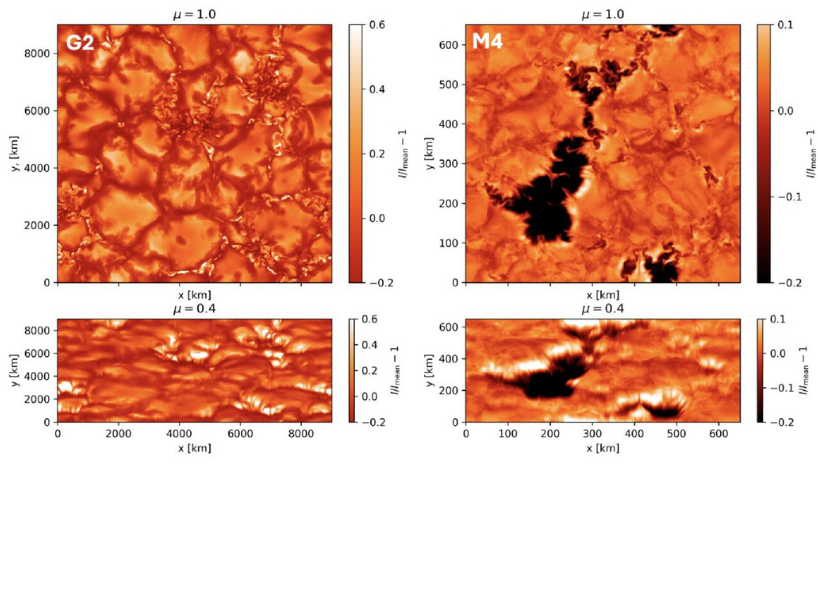
Simulated flares on a Sun-like star (left) and a cool red dwarf star (right). ©Shapiro et al. (2026)
©Shapiro et al. (2026)

Simulated flares on a Sun-like star (left) and a cool red dwarf star (right), shown at a wavelength of 600 nanometers.

Magnetic fields that make our Sun appear brighter can darken cool red dwarf stars – this is shown by a new publication based on detailed computer simulations.

Magnetic regions that brighten the Sun can appear dark on cool red dwarf stars. Researchers at the University of Graz and their international partners have investigated this effect using computer simulations. The study was selected by editors of journals published by the American Astronomical Society (AAS) for a Highlight on AAS Nova, the Society’s research highlights service.

Faculae, the small bright magnetic structures on the Sun, have never been observed directly on another star. Astronomers interpreting the light of other stars have therefore generally assumed that magnetic regions elsewhere behave as they do on the Sun. The Graz team put this assumption to the test.

Magnetic fields suppress the convection that carries heat to a star’s surface, so magnetic regions receive less heat from below and tend to become dark. At the same time, the magnetic field reduces the gas density inside them, allowing us to see deeper, hotter layers. On the Sun, this second effect dominates and faculae appear bright. On cool red dwarfs, however, the magnetic structures are shallower, and the temperature rises more gently with depth. The brightening is then too weak to compensate for the reduced heat supply, and the structures appear dark.

Cool red dwarfs are the most common stars in our Galaxy and are currently receiving particular attention in exoplanet research. Because these stars are small, a planet crossing in front of one blocks a comparatively large fraction of its light, bringing the atmospheres of rocky planets within reach of the James Webb Space Telescope. Astronomers analyse the starlight that passes through such an atmosphere to identify its gases. Magnetic regions on the star leave their own imprint on this light and, if not properly accounted for, can imitate features of the planet’s atmosphere. Whether these regions are bright or dark determines how the measured planetary signal is distorted.

Publication:
A. I. Shapiro, S. Seager, S. K. Solanki et al.: The Curious Case of Dark Faculae on M Dwarf Stars. The Astrophysical Journal 1008, 24 (2026). doi.org/10.3847/1538-4357/ae7105

The work was supported by the ERC Synergy Grant REVEAL, coordinated by the University of Graz.

Related news

Petri Käpylä is welcomed as new astrophysics professor

The Department of Astrophysics welcomes Petri Käpylä as new Professor of Computational Astrophysics at the University of Graz. With a distinguished background in stellar astrophysics and computational modelling, Petri Käpylä brings extensive expertise in the study of solar and stellar convection and dynamos. His innovative research, including leadership of the ERC Advanced Grant "NEOCON," will further strengthen the department’s research and teaching in computational astrophysics.

Cycling Adventure: Guest reseacher Gregory Kopp Tours Austria

During his stay as a guest researcher at the University of Graz, Gregory Kopp embarked on an impressive five-day bike tour: from Lienz over the Großglockner High Alpine Road, through Zell am See, into Berchtesgaden and to Königsee in Germany, then through Salzburg and along the lakes to the east, and finally south to Hallstatt. Covering more than 340 km and about 6,000 meters of elevation, this route took him through some of Austria’s most stunning scenery.

Book launch by Professor Arnold Hanslmeier at Graz City Hall on 29. April 2026

Accelerated communication with the Kanzelhöhe: solar observatory moves closer to the university

From mid-December, the train journey from Graz to Villach will be reduced to just over an hour. This faster railway connection through the Koralm Tunnel will also bring the Kanzelhöhe Observatory for Solar and Environmental Research closer. Although this unique research station at 1500 metres above sea level is located on the Carinthian Gerlitzen, it has been part of the University of Graz for more than 75 years.

Begin of page section:
Additional information:

University of Graz
Universitaetsplatz 3
8010 Graz
Austria
  • Contact
  • Web Editors
  • Moodle
  • UNIGRAZonline
  • Imprint
  • Data Protection Declaration
  • Accessibility Declaration
Weatherstation
Uni Graz

End of this page section. Go to overview of page sections

End of this page section. Go to overview of page sections

Begin of page section:

End of this page section. Go to overview of page sections