


Solar and Heliospheric Physics
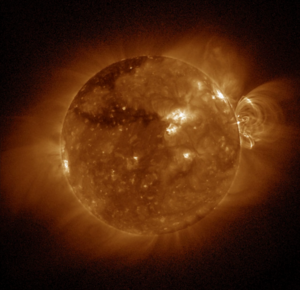
The sun is the closest star to us and the source of all life on earth. The sun is also a special star in astrophysics because it is the only star that is close enough for us to spatially resolve surface details.
Charged particles continuously flow from the Sun into space and form the so-called solar wind. The solar wind shapes the structure of our heliosphere, the region of space dominated by the Sun, which surrounds our star and extends out to the outer planets. From time to time, this continuous outflow of the solar wind is interrupted by huge ejections of magnetised solar material, known as coronal mass ejections (CMEs).
Coronal mass ejections and their associated high-energy radiation bursts from the Sun, called solar flares, are the most energetic events in our solar system and can cause strong disturbances in space weather near Earth.
The physical driver behind all these energetic phenomena is the Sun’s magnetic field, in particular the strong magnetic fields found in sunspots.
Research topics
The Physics of the Sun and the Heliosphere working group at the University of Graz conducts research on the following topics, among others:
Flares and coronal mass ejections (CMEs) are the most energetic events in our solar system. CMEs are magnetized plasma clouds that are ejected from the Sun at speeds of hundreds to thousands of kilometers per second, disrupting the coronal magnetic structure and the steady flow of the solar wind. Flares are sudden, localized enhancements of solar radiation caused by impulsively heated plasma and accelerated particles. The occurrence frequency of flares and CMEs varies with the 11-year activity cycle of our Sun.
We study the energy-release processes in solar flares and CMEs, the underlying magnetic instabilities, the acceleration of high-energy particles, and their interaction with the solar atmosphere. We use data from various ESA and NASA satellites, such as Solar Orbiter, Parker Solar Probe, the Solar Dynamics Observatory, and STEREO, as well as our own observations from the Kanzelhöhe Observatory for Solar and Environmental Research.
Coronal mass ejections (CMEs) are huge clouds of magnetized plasma that are ejected from the outermost layers of the Sun at speeds ranging from a few hundred to 3000 kilometers per second. The fastest CMEs can reach Earth in less than a day after being ejected from the Sun and can cause severe geomagnetic storms when they hit Earth’s magnetosphere.
We are working to better understand the expansion and propagation of CMEs through the space between the planets in the inner heliosphere in order to better predict the arrival of CMEs and their impact on Earth’s atmosphere. This knowledge is crucial, as strong CMEs are the main cause of severe space weather disturbances at Earth, jeopardizing our modern technological infrastructure, especially satellites in Earth orbit and power grids on the ground.