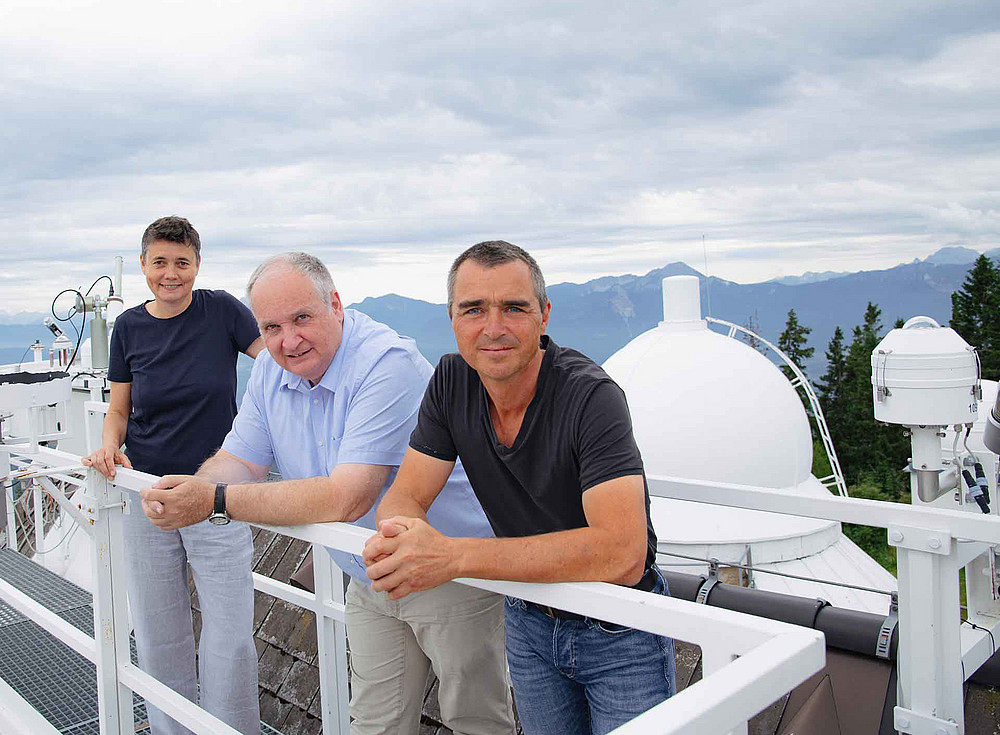
"We work very closely online between Graz and Kanzelhöhe, because personal dialogue is important in science too," explains Astrid Veronig, head of the observatory. In addition, questions can be discussed directly with the team on site and checked with the help of the measuring devices.
"Accessibility is now also much more convenient and faster for students who are completing internships or Master's theses at Kanzelhöhe, for example," says the astrophysicist happily.
One of the core tasks is observing the Sun and the Earth's atmosphere. And there is a lot to see at the moment. This is because there is currently a high level of solar activity and this will continue into the coming years. This manifests itself in the form of so-called coronal mass eruptions, in which plasma is ejected into space and has a massive impact on space weather. Effects on satellites, for example, can then also be felt on Earth. "We recently developed another telescope to specifically observe shock waves caused by strong eruptions," explains Veronig. The scientists take a close look at the Sun's chromosphere through a special filter in the H-alpha light of hydrogen.